Showing posts with label renewables and economic development. Show all posts

Thursday, July 30, 2009

Obama Administration Announces Billions in Lending Authority for Renewable Energy Projects and to Modernize the Grid

Loan Guarantees Will Help Create New Jobs while Fostering Clean Energy Innovation

Washington, DC – U.S. Energy Secretary Steven Chu announced today that the Department of Energy will provide up to $30 billion in loan guarantees, depending on the applications and market conditions, for renewable energy projects. Another $750 million will support several billion dollars more in loan guarantees for projects that increase the reliability, efficiency and security of the nation’s transmission system. The two new loan guarantee solicitations announced today are being funded partly through the Recovery Act and partly through 2009 appropriations.

“These investments will be used to create jobs, spur the development of innovative clean energy technologies, and help ensure a smart, strong and secure grid that will deliver renewable power more effectively and reliably,” said Secretary Chu. “This administration has set a goal of doubling renewable electricity generation over the next three years. To achieve that goal, we need to accelerate renewable project development by ensuring access to capital for advanced technology projects. We also need a grid that can move clean energy from the places it can be produced to the places where it can be used and that can integrate variable sources of power, like wind and solar.”

The lending authority includes:
- Up to $8.5 billion in lending authority supported by 2009 annual appropriations for renewable energy.
- Up to $2 billion in subsidy costs, provided by the Recovery Act, to support billions in loans for renewable energy and electric power transmission projects.
- Up to $500 million in subsidy costs to support loans for cutting edge biofuel projects funded by the Recovery Act.
- Up to $750 million in subsidy costs, provided by the Recovery Act, to support loans for large transmission infrastructure projects in the U.S. that use commercial technologies and begin construction by September 30, 2011.

The two solicitations issued today mark the sixth and seventh rounds of solicitations by the Department’s Loan Guarantee Program, which encourages the commercial use of new or improved energy technologies to help foster clean energy projects. Applications will be accepted over the next 45 days. The Department has streamlined its processes to accelerate these new loan solicitations. By investing in both renewable energy technology for generating electricity and technologies to modernize the country's transmission system, the Recovery Act targets the full integration of renewable energy sources onto the electric grid.

Read more information on this solicitation and the Department’s Loan Guarantee Program. Additional loan guarantee solicitations funded by the Recovery Act will be announced soon.

Friday, November 07, 2008

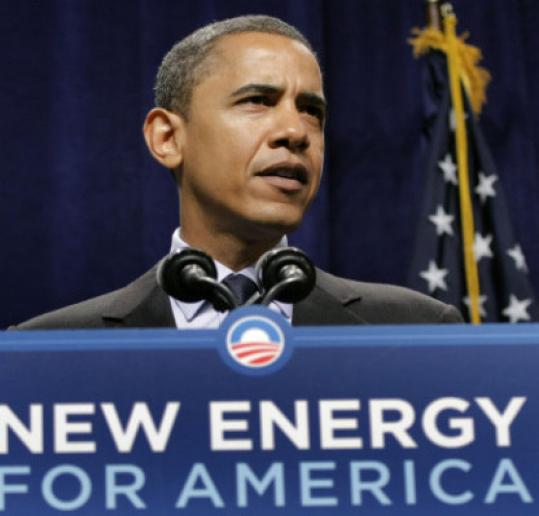
Post-election Poll Confirms Bipartisan Support for Barack Obama's Clean Energy Plans

Cross-posted from the Breakthrough Institute and WattHead - Energy News and Commentary

This week, we've been writing about President-elect Barack Obama's powerful mandate to build a new, clean energy economy and revitalize our nation's ailing economy. A new post-election poll from Zogby Interactive confirms that Americans overwhelmingly view new investments in clean energy as critical to revitalizing America's ailing economy.

The poll found that more than three out of four voters - 78% - support clean energy investments to revitalize the economy, with 50% saying they strongly agree that clean energy investment is vital to the nation's economic future.

Clean energy investments enjoy broad, bipartisan support as well, the poll found. According to Zogby:

"While the vast majority of Democrats (96%) and independent voters (77%) view clean energy investment as a key means to boost the U.S. economy, more than half of Republican voters (58%) also said the same."


Support for clean energy investments is strongest among young voters, African Americans and latinos, three demographics that were critical to Obama's landslide electoral success. Zogby found that:

"Support for clean energy investment is particularly strong among younger voters - 87% of those age 18-24 and 80% of those age 18-29 believe this type of investment is necessary to help improve the U.S. economy. African American voters (94%) and Hispanic voters (84%) also showed overwhelming support for clean energy investment."


"While the economy was the top issue in the 2008 election, clean energy clearly emerged as part of voter expectations for getting the economy back on track," said John Zogby, President and CEO of Zogby International. "Support for action on global warming, already strong in the 2006 election, was even stronger in 2008, particularly among young voters that are the future electorate."

The Zogby Interactive survey of 3,357 voters nationwide was conducted Nov. 5-6, 2008, and carries a margin of error of +/- 1.7 percentage points. The survey was commissioned by the National Wildlife Federation.

President-elect Barack Obama's New Energy Mandate, Part 2

Part 2: Dos and Don'ts

Cross-posted from the Breakthrough Institute and WattHead - Energy News and Commentary

This is the second post in a continuing series delving into Barack Obama's opportunity to capture this political moment and provide a direction for energy policy and economic growth in the 21st century. Part 1 is here.

As Barack Obama assumes the mantle of President-elect of the United States of America, we are witnessing an historic realignment of the American political landscape. With the election of our nation's first African-American president, record voter turnout, and a dramatically redrawn electoral map, it seems that anything is possible now.

However, while Obama clearly has a new mandate to lead our nation, electoral mandates are fickle and even this one could fade in time. President-elect Obama has just 76 days to prepare for his inauguration. Then the real work of governing will begin, and what Obama decides to do in his first 100 days will either cement or erase the wave of popular support the President-elect rides today.

His job won't be easy. On January 20th, President-elect Obama will inherit the White House along with a plethora of pressing challenges all competing for his attention. There will be no time for baby steps, and President Obama must show bold and effective leadership right out of the gate. Furthermore, while the economic crisis will remain his top concern in the short-run, Obama cannot afford to ignore longer-term challenges and must develop synergistic solutions that can tackle multiple problems at once.

Thankfully, Barack Obama has stated that building a new energy economy will be his top priority upon assuming office. If he fully integrates this effort with his shorter-term economic stimulus plans, Obama could effectively tackle several priorities - economy recovery, energy security, and global warming - simultaneously. And getting this job done right could cement Obama's electoral mandate and pave the way for a truly transcendent presidency.


With the all the frantic focus on economic stimulus these days, it's easy to forget that Obama really faces two economic challenges. Yes, we need quick, effective, short term stimulus to pull our nation out of recession. But we also face a longer run economic revitalization challenge that is critical to ensuring our nation's prolonged prosperity.

For too long, we have neglected to invest in our nation. We've let or infrastructure crumble, our schools and universities want for funding, and we've neglected the once-solid pipelines of technological innovation that made us the envy of the world. Blinded by an era of cheap credit and unrestrained consumer spending and bound by a dominant and dogmatic market fundamentalist philosophy of governance, we've seen the light go out of our once vibrant economy. Rekindling the flame of American prosperity will no doubt be the defining task of the Obama administration.

Obama has already made it clear that he believes a new energy economy will be America's next engine of growth. That's smart. There are few (if any) other major growth sectors waiting to be spurred, and building a new energy economy knits together his central economic challenges with other national priorities. And if Obama makes the right decisions in the coming months, his short-term stimulus agenda can be an effective bridge to the longer-term investments necessary to build a new energy economy and secure prolonged American prosperity.

To get it right there a few things President-elect Obama should avoid doing:

  • DON'T be afraid of deficit spending. Obama should ignore the counsel he will no doubt receive from deficit hawks and Clinton-era small-government Democrats to avoid deficit spending and stick to pay-go. And he should not listen if Greens council him to use a full-on cap and trade program to fund all of the spending for his new energy economy agenda. As the spender and lender of last resort during times of economic crisis, reining in government spending would be just as bad for the economy as raising taxes.

    The fact is, deficit spending is necessary for effective stimulus and it's smart for longer-term investments that will net returns for the U.S. Treasury. And with so much demand for U.S. Treasury Bonds, yields on two-year bonds are just 1.3%. After factoring in inflation, that means the government can borrow money essentially for free. All this means that President Obama shouldn't be afraid to borrow and invest if it helps get our nation out of today's recession and lay the groundwork for a new energy economy.

  • DON'T focus on short-term stimulus only. That being said, Obama also cannot afford a myopic focus on stimulus alone or rely solely (or even at all) on cash rebate checks.

    While quick-acting, cash rebate checks are not a particularly effective form of stimulus. In fact, initial studies find considerable evidence that most of the 2008 stimulus checks were put into savings or used to pay down debt. Furthermore, when they do work, rebate checks significantly under-perform investments in infrastructure and direct aid to state governments.

    Perhaps most importantly, if Obama relies on rebate checks to stimulate the economy, he will miss the golden opportunity to make his stimulus investments a bridge to longer-term priorities, like sparking a new energy economy. Given the many challenges he faces as president, Obama cannot afford to miss that opportunity.

  • DON'T propose policies that raise energy bills. While a carbon price would be an important accelerator of clean energy investment and innovation, offering policies that raise energy prices at a time of economic insecurity is a risky political venture (to say the least). Instead, Obama should make the development of clean, affordable energy sources the explicit focus of his policies. To the degree that carbon pricing plays a role in his new energy agenda, President Obama must be clear that the revenue raised will be directly invested in programs that reduce the cost of clean energy alternatives and in energy efficiency programs that will slash the energy bills of households and businesses.

  • DON'T promise short-term fixes to high gas prices. There simply aren't any, and Obama would be smart to use his new bully pulpit and impressive communication skills to make that fact clear to the American public.

    The false promise of "Drill Baby, Drill!" is a disingenuous myth that President Obama should put to rest for good. Oil prices are set in a global commodity market, and the United States simply lacks sizable enough domestic production capacity to have a significant moderating effect on oil prices. If we want to moderate oil prices, we can't do it with a focus on the supply side of the equation, a fact Obama has correctly emphasized by repeatedly saying, "We can't drill our way out of our energy crisis."

    If we want to expand domestic oil production, it shouldn't be motivated by false promises of lower gas prices. To the extent that we do expand drilling operations, it should be to raise revenues for public investment in a new energy economy, or to (modestly) enhance our trade deficit.

    Obama also should make good on his promise to speak openly and honestly to the American people about the challenges we face: the American public needs to hear their President say that while gas and oil prices are low today, they will not remain so for long. According to the International Energy Agency, oil prices will rebound to well above $100 per barrel as soon as the global economy recovers, adding dead-weight just as our economy struggles to stand again. That means that today's temporary relief from $4.00/gallon gas is exactly the time to invest in new, affordable alternatives and efforts to sever our dependence on oil. If he's clear and honest about the challenge of oil dependency, Obama will have further reason to invest in a new energy economy and launch the critical, long-term effort to electrify transportation and create the clean, cheap energy sources we need. If implemented, this strategy will finally free our nation from the volatility of oil prices and the havoc gas price spikes wreck on our economy.

  • DON'T: separate out his clean energy and economic agendas. For too long, clean energy policy was the domain of a relatively isolated environmentalist agenda. Despite it's widespread impacts on issues of national security, economic prosperity and public health, clean energy failed to take it's rightful place as a core progressive issue.

    Now, Obama has successfully transformed clean energy into a bread and butter economic issue. During the closing weeks of the campaign, Obama's clean energy agenda became fully intertwined with his economic recovery plans, and that's exactly where it should stay. A clean energy program will be most effective when fully integrated with the President-elect's economic recovery plans and it should remain a core component of his vision for renewed, long-term prosperity. Clean energy is an economic not environmental issue now, and that's exactly right.
In Part 3 of this ongoing series, we will outline several principles for smart investments in our nation's recovery and the birth of a new energy economy.

President-elect Barack Obama's New Energy Mandate, Part 1

Building a New Energy Economy
Cross-posted from the Breakthrough Blog and WattHead - Energy News and Commentary

Energy policy has never featured more prominently in a presidential election. Both candidates leaned strongly on their energy agendas during the campaign, frequently highlighting their plans to increase America's energy security, reduce energy prices and create jobs.

But while both candidates agreed that energy was a high priority and rhetorically supported an "all of the above" approach to new energy sources, the two candidates proposals actually differed sharply.

Furthermore, Barack Obama enjoyed the most success when his energy proposals were linked to his plans for economic recovery and couched in the rhetoric of job creation. That makes Obama's historic victory a clear endorsement of the President-elect's plans to invest in a new energy economy and argues for further integration of his energy plans into his economic recovery agenda.

While he claimed to support an "all of the above" energy plan, John McCain's energy platform revolved around increasing domestic production of oil and nuclear power.

McCain repeatedly touted nuclear power as his favorite (if not only) answer to our nation's energy challenge, and "Drill Baby, Drill!" practically became the all-encompassing mantra of the Republican party and it's presidential nominee.

McCain's repeated absence from key clean energy votes in the Senate and the selection of Sarah Palin as his running mate and supposed energy czar was the final proof that a McCain-Palin administration would focus centrally on expanding the old energy sources of the 19th and 20th century - oil and nuclear power - rather than the new energy sources of the future.

In contrast, while Barack Obama eventually embraced expanded drilling, he truthfully told the American people that "we can't drill our way out of our energy crisis." Similarly, he voiced conditional support for nuclear power, but made it clear that unresolved issues with nuclear waste and security needed to be addressed before nukes could play a central role in America's energy future.

Instead, Obama called for the creation of a comprehensive new energy economy, with a central focus on increasing vehicle fuel efficiency, electrifying transportation, expanding renewable energy production and retrofitting millions of homes and businesses to be more energy efficient. He considers this effort a new "national project" and promised to fund it to the tune of at least $150 billion over ten years.

Interestingly, Obama didn't really find his voice on energy policy until the economic crisis hit, unseating energy as the top campaign issue.

Back in September, when energy prices were the top election issue and Americans were shouting for quick fixes, Obama fumbled for an adequate response. In many ways, this was understandable, since there really are no quick fixes for high gas prices (that is, unless you consider the Bush energy plan - crashing the global economy! - to be a viable solution).

So while Obama had long-ago outlined a detailed and comprehensive energy plan that would spur the creation of clean and affordable new sources of energy in the long-term, he must have felt that telling the American people there was no short-term answer was a dangerous move. It certainly wasn't what Americans wanted to hear, but by remaining largely silent, Obama quickly found himself in the darkest days of the campaign.

Republicans had no qualms about proposing disingenuous solutions to spiking prices at the pump and quickly rallied around "Drill, Baby Drill!" It worked. McCain surged, taking the lead in the polls, and for the first half of September, it looked like Obama was headed towards defeat.

Then the economic crisis hit in all it's fury, and everything changed. The threat of global recession caused oil prices to fall almost as quickly as the Dow, and fears of another Great Depression displaced nearly every other concern.

That's when Obama realized that he was holding an ace up his sleeve: his energy plan.

In the closing weeks of the campaign, Obama hit his stride and brought his energy plan front and center. He touted opportunities to strengthen the American auto industry, bring manufacturing jobs back to American towns and save energy and money while creating new jobs in the energy efficiency sector. And in speech after speech, whenever he mentioned economic recovery and job creation, he talked about investments in clean energy and energy efficiency.

As he outlined his economic recovery plan on October 13th, Obama reiterated his pledge to "create 5 million new, high-wage jobs by investing in ... renewable sources of energy." He included funding for "energy efficient school and infrastructure repairs" in his Jobs and Growth Fund proposal and called on Congress to fast track "$50 billion in loan guarantees to help the auto industry retool, develop new battery technologies and produce the next generation of fuel efficient cars here in America."

In an October 22nd interview with Time magazine's Joe Klien, Obama clearly stated, "[Building a new energy economy] is going to be my No. 1 priority when I get into office," saying, "there is no better potential driver that pervades all aspects of our economy than a new energy economy."

A week later, Obama aired his thirty-minute October 29th TV special, "American Voices, American Stories." In it, he highlighted Seattle-based energy efficiency specialists, McKinstry Company as "a model for the nation," and again pledged to "invest $15 billion a year in energy efficiency and renewable sources of energy, like wind, solar, and biofuels, creating five million clean energy jobs over the next decade -- jobs that pay well and can never be outsourced."

In versions of his "closing argument" speech delivered across swing states in the final week of the election, Obama called for the creation of "an economy that rewards work and creates prosperity from the bottom up," exhorting America to "invest in... renewable energy for our future."

Finally, in his victory speech last night, he reiterated this theme, saying, "There is new energy to harness and new jobs to be created!"

History will record energy and the economy as the top issues of the 2008 presidential campaign. In the face of the mounting financial crisis, Barack Obama's calm assurance was the leadership the electorate was looking for. And as he successfuly united his clean energy and economic recovery proposals, Obama provided the vision of renewed prosperity Americans were hungry for.

Obama's landslide victory carries with it a clear mandate to build the new energy economy he so frequently spoke of. But he should be clear-eyed that this mandate derives from the economic crisis and continue to pursue his energy agenda hand-in-hand with his economic recovery plans.

With so many pressing concerns facing our nation, there will be little time for Obama to tackle issues one at a time. Instead, our nation's 44th President must find innovative and synergistic solutions that can address several priorities at once. We will see his abilities quickly tested. Even before Inauguration Day, Obama will be counted on to offer an economic stimulus agenda, and he'll be expected to act upon his self-selected No. 1 priority, - building a new energy economy - immediately upon assuming office. In fact, the fate of the Obama presidency may very well hang on his performance on this critical first test.

In Part 2 of this series, we will focus on how President-elect Barack Obama can get the job done right and advance an integrated clean energy and economic recovery agenda in his first 100 Days in office.

Thursday, October 30, 2008

Forget Joe the (Unlisenced) Plumber: Here's Troy the Wind Turbine Builder

Cross-posted from WattHead - Energy News and Commentary

Here's the voice of just one of millions of new, clean energy jobs we can create if we spark a new energy economy. Barack Obama has said it's his top priority if elected, so we should expect more people like Troy the wind turbine builder to find well-paying, dignified work that helps put America back on track.


Hat tip to Clean Tech and Green Businesses for Obama.

Monday, October 06, 2008

Time for A Green Bailout? Van Jones Says Clean Energy Investment Can Solve Our Economic and Ecological Challenges

Van Jones is one timely man. With the economic crisis spurring a new search for ways to revitalize and rebuild our flagging economy, Van Jones, the founder and president of Green For All, is ready with answers: "a national commitment to green economic development as a way to address our environmental and economic crises at once."

That's the message of Van's new book, The Green Collar Economy: How One Solution Can Fix Our Two Biggest Problems (due out in bookstores October 7th), as well as the nationwide Green Jobs Now! day of action organized by Green For All last weekend. He couldn't have picked a better time for the book release and the day of action.

The $700 billion economic bailout plan passed last Friday by Congress may get Wall Street back to square one. But Americans on Main Street want more than a bailout. We want a real plan to move forward. We want a plan to create a more sustainable, prosperous and secure future for ourselves and our loved ones.

In a piece in Huffington Post last Friday (reprinted below), Van points out that investments in a 'green bailout plan' - a series of timely, strategic investments to ignite a new clean energy economy and restart our ailing economy - is our best hope, perhaps the only strategy that can move our troubled nation forward into a new era of shared prosperity. This quote from the intro to The Green Collar Economy sums it up well:
"[W]e cannot drill and burn our way out of our present economic and energy problems. We can, however, invent and invest our way out. Choosing to do so on a massive scale would have the practical benefit of cutting energy prices enough—and generating enough work—to pull the U.S. economy out of its present death spiral."
I look forward to cracking open Van's book this evening (I was lucky enough to get an advanced copy), and I encourage you to pick up a copy for yourselves (you can order a copy here). If there's one question that should be on everyone's mind right now, it's how do we get our economy back on track, kick our dirty energy addiction and ignite a new, clean energy economy. I'm sure Van has some answers.

I'll try to post a review of the book once I've read more of it. For now, here's Van's piece from HuffPost (reprinted with permission from Green for All):

"Now For A Green Bailout: Twice The Bang, Half The Bucks"
By Van Jones

Maybe the Wall Street bailout package is a good idea.

But the only thing I know for sure is this: even if we avert a total economic meltdown, we will still be in a recession. Millions of Americans still will be without jobs -- or in real fear of losing their job. Worse, we will still be dependent on dirty fuels like oil and coal, which are draining our monetary resources and cooking the planet.

The Earth and everyday people will still be suffering.

I wrote a new book to propose elegant solutions for our economic and environmental crises. The Green Collar Economy offers a green cure for the dilemmas we face and the financial messes we are in.

At this point, I am willing to concede that Wall Street and the big bankers need some propping up. But while we are at it, we should find a way to bail out the little people -- and the planet, too.

So how about a green bailout -- to help both? We already took an important step in that direction today. Perhaps the only thing in the whole bailout package that is inarguably good is the support for the U.S. clean energy sector.

After unconscionable delays, Congress finally gave a boost to our wind power industries and our solar power industries by extending the Investment Tax Credit (ITC) and the Production Tax Credit. The price tag was about $9 billion, but the cost was entirely offset, mostly by changes that were made to oil and gas tax rules.

What does America get for that no-net-cost shuffling of the tax code? Plenty. The 8-year extension of ITC alone will create 440,000 jobs. And $230 billion of private investment would be created in the solar and other industries, according to a recent report by Navigant Consulting.

Green Bailout: Half The Money, Twice The Impact

That's a good start. Let's keep going. An all-out "green bailout" could give America TWICE the bang ... for half the bucks.

We just found $700 billion. Let's find another $350 billion. That's half the price tag of the Wall Street rescue - which has no guarantee of success. But with $350 billion investment, we absolutely and positively could retrofit and repower America using clean, green energy - and create millions of new jobs, in the process.

A new report just released by the U.S. Conference of Mayors says that we can create over 4 million green jobs if we aggressively shift away from traditional fossil fuels toward alternative energy and a significant improvement in energy efficiency.

Another report just released by the Political Economy Research Institute and the Center for American Progress shows that the U.S. can create two million jobs over two years by investing $100 billion in a green economic recovery plan. The report also shows that this investment would create four times more jobs than spending the same amount of money within the oil industry.

Green For All and its partners are proposing a Clean Energy Corps that includes a revolving loan fund to finance the ambitious retrofitting of the nation's building stock. An investment of less than $3 billion per year would provide financing and can be expected to create close to 120,000 green jobs a year and 600,000 over five years, while also lowering home heating and electricity bills for homeowners and small businesses.

Clean Energy Corps: Retrofitting & Repowering America

The United States should have a Clean Energy Corps, combining community service with green-collar job training. Such a program could get hundreds of thousands of people ready to go to work, greening the nation's infrastructure.

The New Apollo Program is a comprehensive economic investment strategy developed by the Apollo Alliance to build America 's 21st century clean energy economy and dramatically cut energy bills for families and businesses. It estimates that the investment of $500 billion over the next 3 years and create more than 5 million high quality green-collar jobs.

It will accelerate the development of the nation's vast clean energy resources and move us toward energy security, climate stability, and economic prosperity. And it will transform America into the global leader of the new green economy.

A massive green economic stimulus package like this could even pay for ITSELF in energy savings and in tax dollars generated by new jobs and businesses.

As Thomas Friedman says, "We don't just need a bailout. We need a buildup." In my new book, The Green-Collar Economy, I spell out other green remedies for our economy.

Friedman: Not Just a Bailout, A Buildup

The bottom line is: we can't base a national economy on credit cards. But we can base it on solar panels, wind turbines, smart bio-fuels and massive, a program to weatherize every building and home in America.

Rather than giving platinum parachutes to those who wrecked the economy, let's throw a green lifeline to the ordinary people who want to rebuild it. We can't drill and burn our way out of our present mess. But we can invent and invest our way out.

Our present economy is based on consumption, debt and environmental destruction. The next U.S. economy should be based on production, smart savings and environmental restoration. You can't have a stable economy based on unregulated greed at the top. But you can have one based on unleashing green, at the bottom.

Millions of green jobs would be a Main Street solution to the Wall Street meltdown.

America's number one resource is not oil or mortgages. Our number one resource is our people.

And it is time to put our people back to work - retrofitting and re-powering America.

That's what my book is all about.


Friday, February 29, 2008

Oil Hits Record Price. Gas Nearing $4.00. President Bush, Clueless…

Happy Friday! Oil hit record-prices today: $103.05 per barrel. Bully for us...

That tops the inflation adjusted high of $102.53 set in 1980. Oil first inched over $100 to welcome in the new year on January 2nd and has hovered around $100 since then, routinely spiking into new record territory. Now we've blown past the final record: the inflation adjusted highs reached in the '80s.

This news comes as analysts predict $4.00 per gallon gasoline when refiners switch over to reformulated blends in Spring.

Of course, you and I already know that. We see it every time we drive past a gas station, or god forbid, actually pull in to fill up our tanks!

You'd assume President Bush would be clearly aware of the state of gas prices as well, given how much they impact average Americans every day. Well, you might assume that about another president anyway... I wasn't too shocked to learn that President Bush is actually completely clueless that gas prices are soaring towards $4.00!

In a press conference today, he revealed his complete ignorance of what life is like for real Americans on the street in an interview that began with a simple question from Peter Maer of CBS News. Here's the transcript of the exchange, courtesy of NTYimes blog, "the Lede":

Q: What’s your advice to the average American who is hurting now, facing the prospect of $4 a gallon gasoline, a lot of people facing –

MR. BUSH: Wait, what did you just say? You’re predicting $4 a gallon gasoline?

Q: A number of analysts are predicting –

MR. BUSH: Oh, yeah?

Q: — $4 a gallon gasoline this spring when they reformulate.

MR. BUSH: That’s interesting. I hadn’t heard that.
"I hadn't heard of that?!" Seriously?! Well that explains a lot...

Like why President Bush has routinely blocked the US Congress's fiscally responsible attempts to re-invest wasteful oil subsidies to kick-start new sources of clean, homegrown renewable energy.

Three times now, the House of Representatives of the 110th Congress has passed bills that would end wasteful subsidies to oil companies designed to spur domestic oil exploration at a time when oil priced in at about $20.00/barrel. With oil prices at record levels over five times higher than when Bush took office, it's simply fiscally irresponsible to shower an industry recording record profits with taxpayer subsidies while denying the most promising and fastest growing clean, homegrown renewable energy technologies critical incentives that spur their growth.

The House passed their third attempt to correct this irresponsible tax spending and shift funds to extend critical renewable energy and energy efficiency tax credits, as well as support purchases of plug-in hybrid electric vehicles. Perhaps the third time's a charm, but this victory could be short lived, with President Bush again threatening to veto and a Republican-led filibuster in the Senate expected (again!).

But I guess if President Bush doesn't have a clue what oil and gasoline prices are really like these days, he can be forgiven for ignorantly and irresponsibly defending oil subsidies to Exxon, Chevron, ConocoPhillips and friends... These oil companies are incidentally reaping record profits off of the record prices paid by every-day Americans at the pumps, all while the economy tanks... But maybe President Bush doesn't know that either.

So maybe we should go light on President Bush... After all, he doesn't know any better!

But WE, the every day American tax payer do!

WE know that lavishing subsidies on established and highly profitable industries is a pretty poor use of taxpayer money.

We ALSO know that subsidizing the energy industries of the past will not help us solve the energy challenges of the future! To do that, we're going to have to be Energy Smart! We're going to have to invest in new, clean, domestic energy sources like wind, solar, geothermal, energy efficiency, new 100+ mpg plug-in hybrid cars and more in order to have an energy supply that is sustainable, both environmentally AND economically.

WE know better, so let's let the Senate and President Bush know it's time to re-invest! Let your Senators know it's time to be smart with our energy subsidies.

Tell the Senate to pass H.R. 5351 the Renewable Energy and Energy Conservation Tax Act of 2008 so we can take a step towards a sustainable, prosperous and secure America!